1929
The Graf Zeppelin’s first full year of operations brought several noteworthy flights. In March, the airship flew south to the Holy Land on its “Orient Flight”, loitering below sea level over the Dead Sea and dropping mail at Er Ramle, Palestine. On the return flight to Germany, the new world met the old when the ship passed over ancient Athens and the Acropolis.
That success was followed by a near-disaster in May, when the airship attempted a flight to North America and was forced to make an emergency landing at Cuers, France when four of the ship’s five Maybach engines failed. The trip was successfully resumed from Friedrichshafen in August, with the airship arriving at Lakehurst on August 5th.
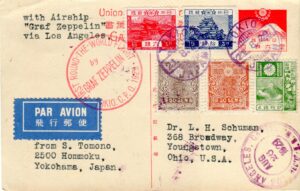
From there, the Graf Zeppelin undertook what was arguably its signature achievement, the Around-The-World Flight. The first segment saw the ship travel back to Friedrichshafen. From there, the LZ 127 flew over the vast expanses of Russia and Siberia to Tokyo. The ship then headed east over the Pacific to Los Angeles, where it made another stop before heading to New Jersey, completing the “American” Around-The-World Flight from Lakehurst to Lakehurst in just 21 days. From there it flew back to Germany, marking the completion of the “German” Around-The-World Flight from Friedrichshafen to Friedrichshafen. In the process, the ship carried mail from the U.S., Germany, Japan, and six other nations.
1929 also saw the introduction of unique flight cachets that were applied to mail from the airship’s major flights. These collectible flight cachets ignited a “zeppelin fever” in the philatelic world, with every collector wanting mail flown on the Graf Zeppelin.