1930
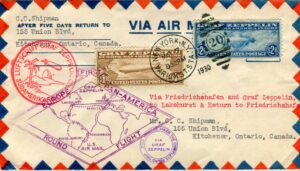
Hugo Eckener, the Commander of the Graf Zeppelin and head of the Zeppelin Company, envisioned an eventual zeppelin passenger and mail service between Germany and South America. To advance that goal, he planned a demonstration flight that would see the Graf Zeppelin fly in a triangular route from Friedrichshafen to Recife, Brazil, then north to Lakehurst, and finally, back to Friedrichshafen. The so-called “Pan-American Flight” was successfully executed in May and early June of 1930, helping to lay the groundwork for an eventual South American service. In addition to German mail, the Pan-American Flight carried mail from Spain, Brazil, a number of other European and South American Countries, and the United States, which issued the three famous Graf Zeppelin stamps for use on the flight.
Other notable 1930 flights included a journey to England, a pair of flights to Norway, a landing flight to Moscow, and a Baltic Sea Flight that saw the airship drop mail over Berlin, Germany; Riga, Latvia; Tallinn, Estonia; Helsinki, Finland; and Stockholm, Sweden. After several local flights within Germany and to northern Switzerland, the year ended with a trip to the Netherlands.